Abstract
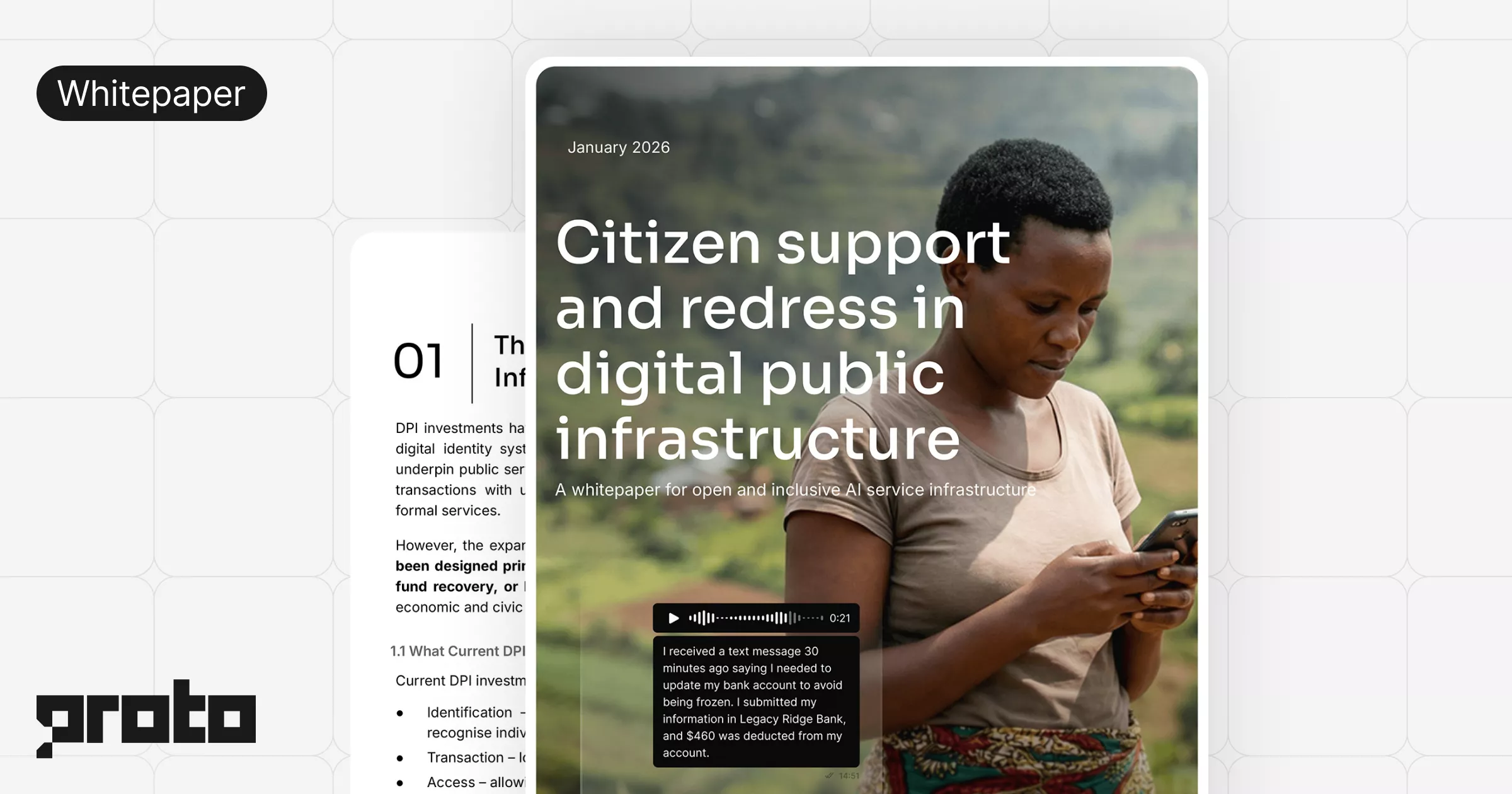
This whitepaper examines a mission-critical yet underdeveloped layer in digital public infrastructure: the systems with which citizens interact, seek redress, and resolve disputes. While global DPI investments have scaled foundational layers such as digital identity and payments, far less attention has been given to the systems required to manage citizen interactions, complaints, fraud, and service failures at national and cross-border scale. Drawing on AI-based grievance redress deployments, including capabilities for local language communication and sovereign data hosting in Africa and Asia, this whitepaper sets out a tiered pathway for open-sourcing and institutionalising citizen support and redress as core public infrastructure. This paper is intended as a guide to coordinate regulators and government agencies, development partners, and philanthropic organisations seeking sustainable models to ensure trust in digital systems.
“The citizen reports a problem in the channel they already use, and the state’s digital infrastructure absorbs the complexity of categorisation, routing, and institutional accountability.”
This paper draws on live deployments with regulators in Africa and Southeast Asia, including AI redress agents operating in local languages such as Tagalog, Kinyarwanda, and Oshiwambo, and proposes a parallel, tiered model for development and philanthropy partners:
- Tier 1: Interventions to place citizen redress high-risk public services
- Tier 2: Conversion redress technology into open-source components
- Tier 3: Local language APIs that extend AI into underserved communities
The core idea is simple:
Trust, interoperability, and linguistic inclusion can be designed into digital systems – but only if citizen interaction and grievance redress are treated as shared infrastructure, not one-off projects.
Key takeaways
These key takeaways are grounded in evidence from live national deployments and focus on practical design choices that determine whether digital systems build long-term trust or expose new systemic risks.
- Citizen support and redress are no longer optional add-ons – they are core infrastructure required to sustain trust in scaled digital public systems.
- Most digital public infrastructure investments focus on identity, payments, and access, while leaving governments without institutional capacity to handle failures, disputes, and fraud at scale.
- Treating grievance redress and online dispute resolution as shared, institutional infrastructure reduces fragmentation, lowers costs, and improves accountability across agencies.
- Live national deployments show that AI agent networks can automate high-volume redress workflows, improve resolution timelines, and deliver material consumer outcomes such as refunds – without sacrificing sovereignty or oversight.
- A tiered pathway enables countries to move from funded priority deployments, to interoperable public infrastructure, and ultimately to local language and workforce participation.
- Designing redress systems for sovereignty, interoperability, and local language access is essential to inclusion, legitimacy, and long-term sustainability in low- and middle-income countries.
- Development funding has the greatest impact when it acts as a catalyst – establishing durable public capacity that transitions to shared-service and domestic financing models.

