
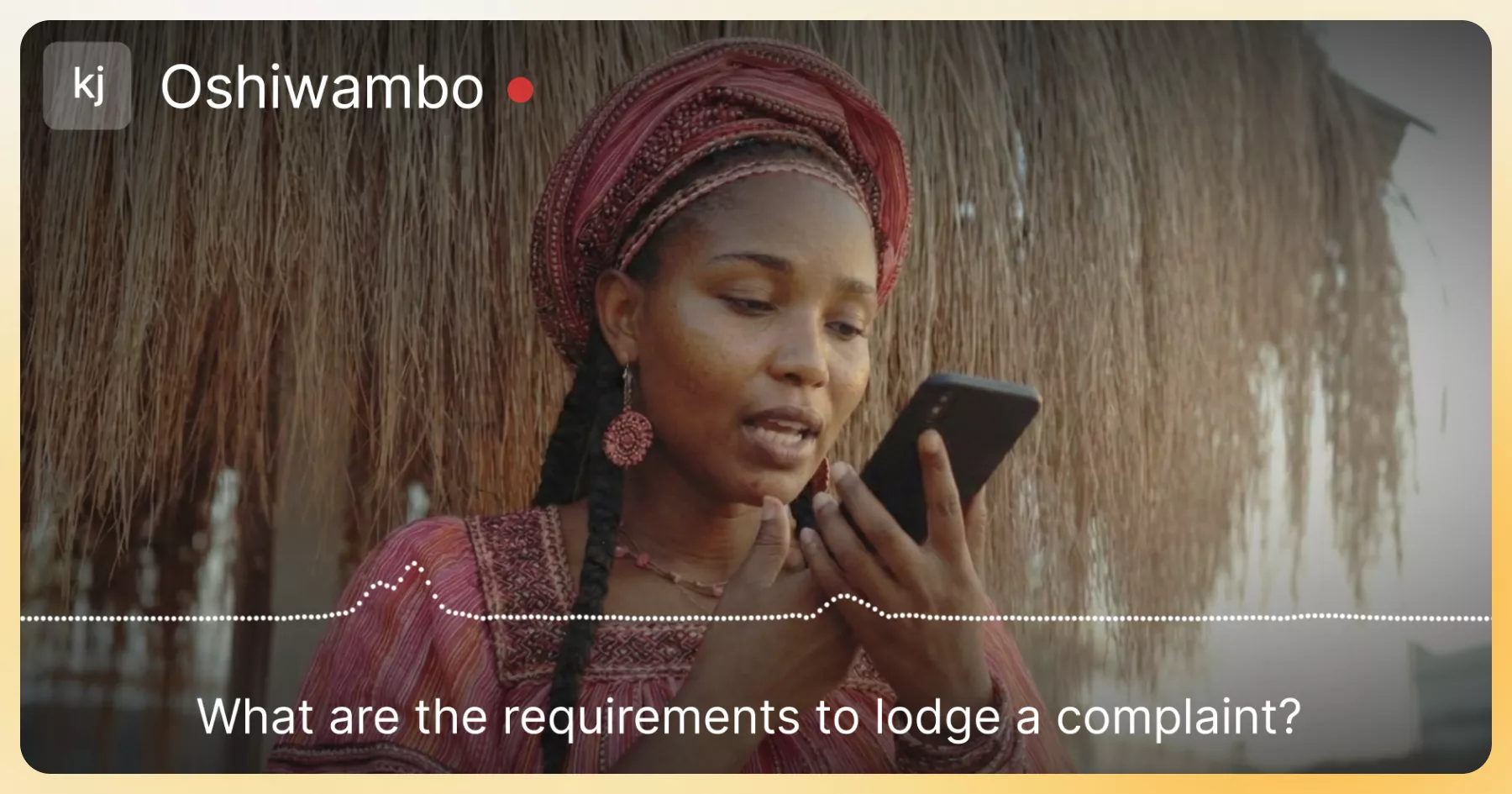
Proto released Oshiwambo voice support into its AI agent network for the Namibian government, expanding immediate access to financial consumer recourse and scam reporting in the country’s most widely spoken local language.
Oshiwambo is spoken by an estimated 45–50% of Namibia’s population, yet it has long been excluded from commercial voice AI systems. Limited data availability, regional dialect variation, and widespread code-switching with English have made both text and voice modelling particularly challenging. As a result, many digital services have remained inaccessible to Oshiwambo-speaking citizens, especially outside urban centres.
Deployment by Namibian institutions
Oshiwambo voice AI is already in use within national-level ConsumerConnect system operated by the Bank of Namibia and the Communications Regulatory Authority of Namibia, where it supports complaint intake, service guidance, and consumer protection workflows as part of Namibia’s multi-agency digital infrastructure.
A real production sample generated by Proto’s Oshiwambo text-to-speech model. The message says "In order for your complaint to be noted, provide the organisation name, contact number, proof of interaction, ID and full description of the complaint."
A real production sample generated by Proto’s Oshiwambo text-to-speech model. The message says "Once we receive your complaint, you will receive feedback within 15 days. If no feedback has been received, you can contact us to give you feedback."
Local language AI from the ground up
There was no off-the-shelf AI model – or training data – that could meet the accuracy, reliability, and audit requirements needed for institutional deployment.
Proto employed Oshiwambo-speaking university student in Windhoek to translate, annotate, and record audio samples with accurate pronunciation and everyday speech patterns. These recordings underpin both the speech recognition and voice synthesis models now running in production.
The work addresses structural gaps common to low-resource languages, including scarce labelled data, inconsistent orthography in written Oshiwambo, and the absence of established evaluation benchmarks. Rather than adapting models trained on high-resource languages, the Oshiwambo voice layer was developed and validated specifically for these conditions by Proto’s R&D team led by CTO Weiying Kok.
Benchmark snapshot
Text-to-speech – Oshiwambo
Speech-to-text – Oshiwambo
These performance metrics reflect the scale of achievement. Accuracy and fallback rates are improving continuously as additional real-world Oshiwambo voice data is captured through active deployments and incorporated into supervised evaluation and retraining cycles.
The Oshiwambo rollout forms part of Proto’s broader commitment to building inclusive AI infrastructure, ensuring that underserved populations are excluded from the world’s newest economic opportunities.