 Kinyarwanda
 Oshiwambo
 Tagalog
 Punjabi

A consortium comprising the National Bank of Rwanda (BNR), Proto, Financial Network Analytics (FNA), GLEIF and the University of Manchester has won the AI-Driven Fraud & Scams challenge at the 2026 C:>DIR Global ‘Agentic Regulator’ Hackathon, organised by the Cambridge Digital Innovation and Regulation Initiative (C:>DIR), an initiative of Financial Innovation for Impact (FII).
The competition attracted 336 concept-note submissions, with the winners announced at the C:>DIR Summit in Cambridge on 18 September. BNR will receive a cash prize associated with the win.
The consortium demonstrated how an AI-assisted workflow can connect a consumer’s scam report to fund tracing, recovery and fraud intelligence, while keeping consequential enforcement decisions with authorised humans.
Global bank-fraud and scam losses reached $579 billion in 2025, including $62 billion from scams, while Interpol fraud-related notices rose 54% year on year. In Rwanda, 67% of respondents said they had been targeted by fraud in the previous three months and 10% had lost money – even as the country’s eKash instant-payment rail processed 10.5 million transactions worth RWF 960 billion in its first three weeks from 14 July 2026.
Building on Rwanda’s existing AI agent
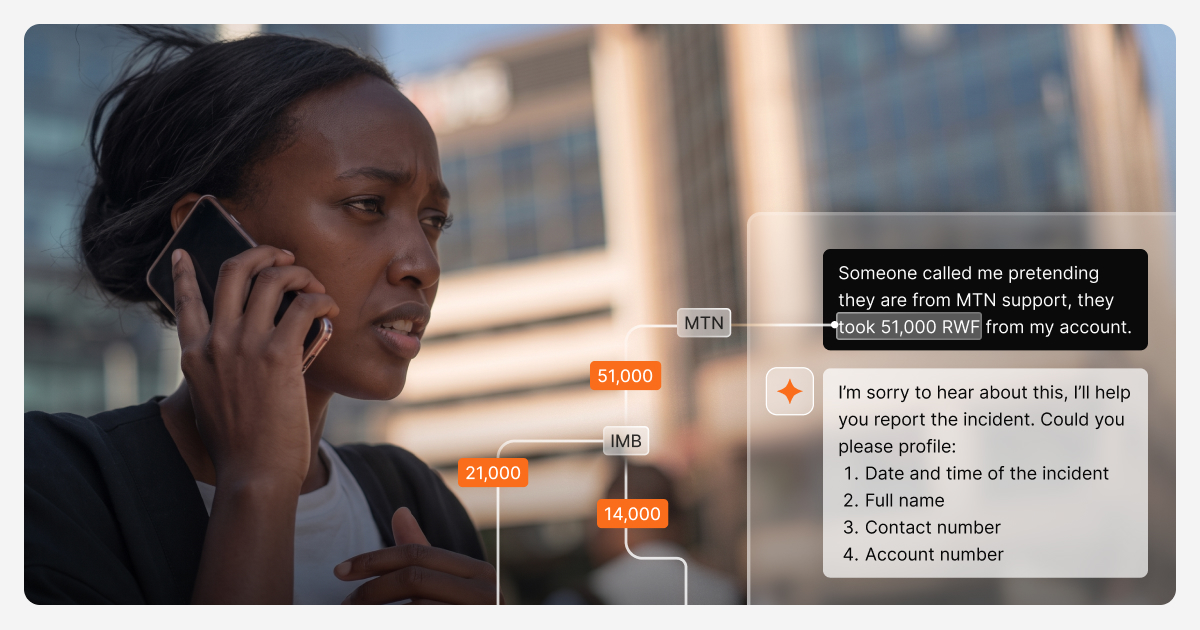
BNR is already a Proto client for Intumwa, an AI agent that lets consumers submit financial complaints conversationally in Kinyarwanda, English and French. That deployment has produced measurable results: average complaint-resolution time has fallen from 35 days to four, while the share of complaints submitted by women has doubled from under 10% to 20%.
For the hackathon – which the consortium entered as a finalist in September – the team extended Intumwa from grievance redress into anti-scam response. The winning prototype linked six connectors around one shared case record, with every output treated as a recommendation until an authorised human approves an irreversible action.
The six connectors behind the winning prototype
- Grievance intake – Proto captures a report conversationally in Kinyarwanda and structures the case in about a minute.
- Redress and escalation – Proto attempts resolution where appropriate or escalates the scam report into the anti-scam workflow.
- Fund tracing – FNA Money Trails maps the movement of stolen funds across mule accounts in real time.
- Recovery – FNA prepares the evidence and freeze/seizure packet required for authorised recovery action.
- Supervisory insights – closed cases are converted into fraud typologies and regulatory intelligence for BNR.
- Detection – those typologies are used to flag anomalous transaction and mule-network patterns and feed intelligence back into fraud prevention.
A cross-border bridge packages the relevant case information and freeze request for a peer anti-scam authority when stolen funds move into another jurisdiction. The eKash/RNDPS connector is read-and-flag only – it can surface suspicious transactions but cannot debit or move funds. Freezes, reimbursements, cross-border requests and public warnings all stop at a named human approval gate.
Curtis Matlock, CEO of Proto, said: “Rwanda already has the AI agent and grievance-redress infrastructure in place. This challenge was about connecting that front door to the ability to follow the money and help consumers recover what they have lost.”
From grievance redress to recovery
The work builds on an existing Proto–FNA collaboration. In 2025, the two companies won a G20 TechSprint award for Trust at Speed: A National Utility for Scam Reporting and Fund Tracing, linking consumer scam reporting with financial-network tracing and recovery. FNA’s Money Trails technology provides the fund-tracing component of the Rwanda prototype.
The benchmark is already visible in Malaysia: FNA’s National Fraud Portal increased fund-freezing rates for promptly reported cases from 0.5% to 21.5%, while Bank Negara Malaysia has reported a 75% reduction in time-to-trace.
Dr Kimmo Soramäki, CEO of FNA, said: “Fraud does not stop at an institution or a national border. Connecting reporting directly to transaction tracing is what turns a complaint system into a genuine recovery capability.”
What’s next
The next step is to build on the winning prototype with BNR and Rwanda’s financial ecosystem, while exploring how the same model can support cross-border cooperation between regulators and financial institutions.
The C:>DIR win demonstrates how existing consumer-redress infrastructure can evolve into a broader anti-scam trust layer – connecting reporting, tracing, recovery and prevention.