 Kinyarwanda
 Oshiwambo
 Tagalog
 Punjabi
The pilot
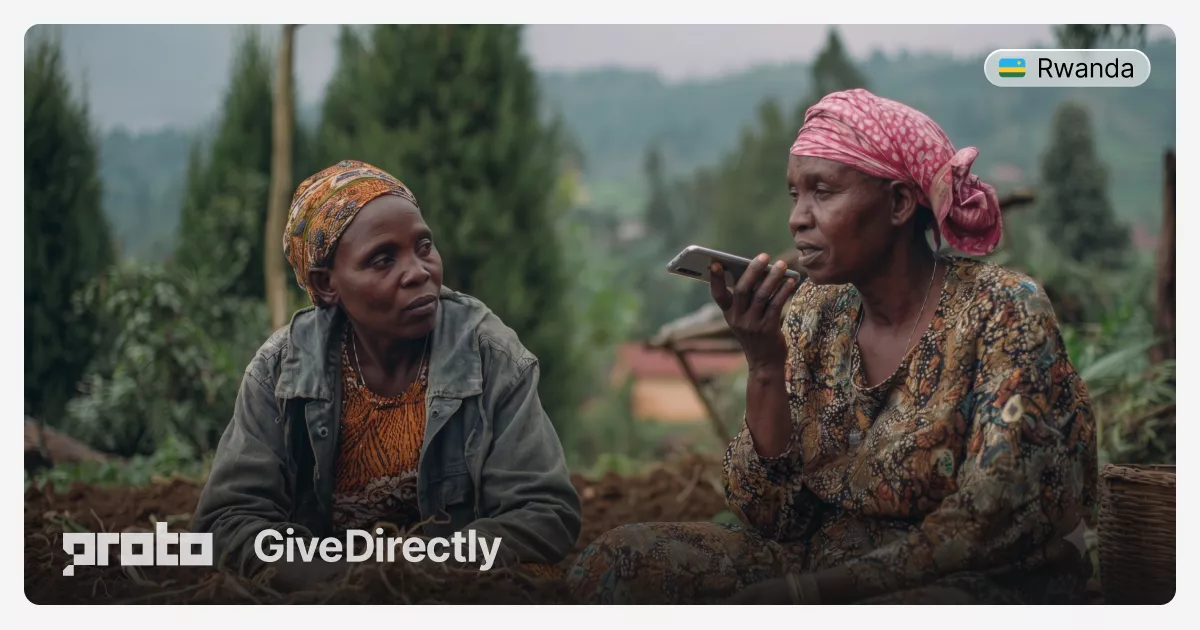
Alongside its usual one-time cash transfers of roughly US$1,000, GiveDirectly offered recipients in rural Rwanda an AI chatbot over WhatsApp – a platform many already use – so they could ask questions in a familiar tool. The scale of engagement was substantial: more than 21,000 inbound interactions from 832 recipients between November 2025 and April 2026, spanning text, voice notes, photos and menu taps. The pilot was funded by the Imara Fund, an Africa-focused foundation co-founded by Reed Hastings and Constance Jones.
What recipients did with it is the interesting part. GiveDirectly expected questions about the programme, spending decisions and business ideas – and people did ask those. But they quickly moved to the ordinary, high-stakes decisions people bring to AI everywhere: how to manage a family conflict, what to do about a sick child, where to find markets beyond their community, who they can trust. In places where a health worker, business coach or legal-aid office may be hours away or simply absent, putting that kind of second opinion within reach is no small thing.
“The robots work at night”
One of the clearest findings was about timing. Traditional coaching and support programmes run during the day, at fixed hours, in groups. But many recipients spend daylight hours tending farmland or working a market stall. Chatbot usage peaked in two windows – a quick question at midday between tasks, and again late in the evening once formal services had long closed and the children were asleep. As one recipient put it in a focus group: “the robots work at night.” For many, that round-the-clock, private, judgment-free availability was part of the value.
Where Proto comes in
GiveDirectly was refreshingly candid about the limits of LLMs, and the biggest one is language. Across mainstream large language models, support for African languages like Kinyarwanda is inconsistent, and voice – the primary interface for many lower-literacy users – is often unreliable or poorly adapted. As GiveDirectly notes, a handful of specialist vendors are starting to close that gap, and it is among the first users of Proto joining later in the pilot as a comparison to LLMs.
This is exactly the problem Proto’s local-language models are built for. Our proprietary AI engine is designed for low-resource settings that generic models handle poorly: high-accuracy intent recognition in Kinyarwanda, voice trained on real local speech rather than a converted English voice, and robust handling of the mixed-language, informal phrasing people actually use. The same capability proven at national scale in Rwanda – through the National Bank of Rwanda’s Intumwa AI agent – is what helps an effort like this reach the lower-literacy, rural users who are otherwise left at the margins of the AI ecosystem.
Why it matters
GiveDirectly frames the world’s poorest communities not as an edge case for AI, but as one of the clearest tests of whether these tools actually work for the people who could benefit most. We agree. A cash transfer changes what someone can afford; access to the right information, at the right time, in their own language, changes what they can do with it. Closing the language and voice gap is what turns a promising pilot into genuine inclusion – and it is the work Proto exists to do.
Read GiveDirectly’s full write-up of the pilot.
About GiveDirectly
GiveDirectly, the global non-profit known for delivering cash directly to people living in extreme poverty, has been testing a question that matters far beyond its own programmes: can an AI chatbot actually help the world’s poorest, in their own language? Its pilot in rural Rwanda offers an early, honest answer – and Proto is part of how the language gap gets closed.