

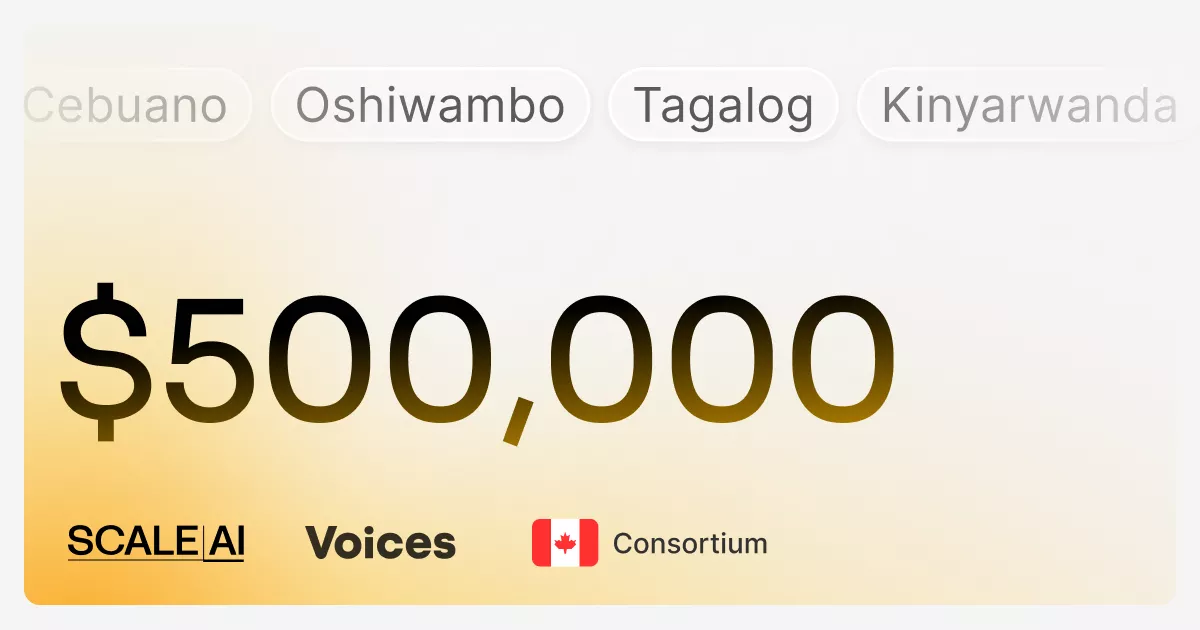
ScaleAI, an innovation cluster dedicated to accelerating the adoption of Canadian artificial intelligence, has announced a grant of US$500,000 into a Proto-led consortium to advance voice AI capability for underserved languages.
Through the partnership with ScaleAI, Proto will upgrade its AI agents with automated speech recognition capability for languages such as Tagalog and Kinyarwanda. Such languages, often referred to as low-resourced due to a lack of training data, have hitherto been unsupported in the rapidly growing generative AI customer experience industry.
Canada's Minister for Artificial Intelligence Evan Solomon said: "Canada is proud to support innovations that make AI more inclusive and accessible. This project demonstrates how AI can bridge language barriers and ensure that technology serves all communities, particularly those that have been historically underserved. ScaleAI's investment in Proto exemplifies our commitment to building an AI ecosystem that reflects Canada's values of diversity and inclusion."
These enhancements will localise and improve the performance of Proto's active deployments within the government, healthcare, transportation, and digital finance sectors – with critical support from the project's Canadian consortium contributors such as Voices.com.
Proto CEO Curtis Matlock said: "We're grateful to ScaleAI for supporting Proto and its consortium. This project overcomes the training data challenge for underserved languages. By solving this, we can provide viable voice AI models for citizens in countries where literacy challenges and a preference for speech messaging are common."
Voice AI for local and mixed languages
The absence of training data for low-resourced languages is a major barrier to multilingual support automation. This inequality is widened by large language models, which are 93% trained on dominant languages like English.
To close this divide, Proto augments LLM-powered agents with its natural language understanding engine, specialised in local and mixed languages in Southeast Asia and Sub-Saharan Africa. However, meaningful improvements in text accuracy and speech word error rates (WERs) require a massive volume of training data. Such data is difficult to source due to poor translation quality, data privacy limitations, and noise interference. Often, useable data can be limited to a single translation of a common document, like a constitution or the Bible.
To solve this, consortium partner, Voices.com, has been delivering 500 hours of spoken recordings for prioritised languages, including dialects within languages like Cebuano and Oshiwambo. This contribution is key to the project's main deliverables:
- Automated speech recognition trained on three sources: public-domain voice datasets, the 500 hours of high-quality audio recordings from Voices.com, and 500 hours of synthetic speech generation.
- Text-to-speech (TTS) with a WER of 5-10%, trained on synthesised responses generated from chat transcripts and the recordings from Voices.com. Proto is also leveraging public-domain speech dataset to ensure the output is natural-sounding, mimicking human speech patterns.
Four voice language models are currently in active fine-tuning and already available in the platform – Tagalog, Cebuano, Kinyarwanda, and Oshiwambo. Listen to samples from completed local language models:
Our local voice models also support cross-lingual or mixed-language communication. This is especially important for languages that have evolved with loanwords and technical terminology from dominant languages. In the Philippines, for example, the mixed language Taglish – combining Tagalog and English – is routinely spoken in everyday interactions.
The following benchmarks are based on the current performance of these four language models as of December 2025:
91.03% average accuracy rate
91.03% average accuracy rate
8.97% average word error rate
8.97% average word error rate
1.75s average response speed
1.75s average response speed
To support voice interactions in real service settings, Proto has built features that manage how audio is used across channels and languages. Voice messaging is available on Webchat, Messenger, Telegram, and WhatsApp, allowing organisations to provide voice-enabled support within the digital channels that citizens and customers already use.
Conversations adapt automatically through dynamic response matching. When a user sends a voice message, the AI responds in audio; when the user switches back to text, the AI follows with text. This preserves natural conversational flow, avoids unnecessary audio playback, and ensures that voice interactions remain intentional and easy to review by service teams.

While the ScaleAI project focuses on improving performance for underserved and local languages, Proto's voice capabilities also extend to a wider global language set supported by large language models. This ensures that organisations can deploy voice AI across both dominant and local languages without being constrained to a fixed or narrow list, while maintaining consistent behaviour across all supported channels.
The new voice capabilities are now being applied to Proto's live government and enterprise deployments across across usecases such as patient experience, anti-scam centres, and insight advisors – enabling customers and citizens to submit complaints, check transaction issues, and access services in their preferred spoken language.
Empowering governments with AI consumer protection
The most widespread social impact from this ScaleAI project is to be seen in Proto's parallel work with the Gates Foundation, which is supporting a global rollout of AI-based consumer protection technology. In partnership with financial and cybercrimes regulators in the Philippines, Rwanda, Namibia, and Mozambique, Proto is deploying integrated AI agents for government agencies to rapidly process citizen complaints and scam reports. Anecdotal feedback from these government agencies indicates that senior and rural citizens have a clear demand for voice-based engagement – and may otherwise not seek support from public institutions.
The accessibility of consumer protection is critical as financial scams surged beyond $1 trillion last year, according to the Global Anti-Scam Alliance. These scams increasingly target the newest – an often most vulnerable – financial consumers in developing countries, threatening to erode public trust and undo the advances of the past decade's financial inclusion initiative.
For example, in the Philippines, the ScaleAI project's focus on the five most spoken languages – Tagalog, Cebuano, Ilocano, Hiligaynon, and Bicolano – is particularly significant for including the majority of Filipino citizens in their preferred spoken language. This initiative builds on Proto's text-based deployments for government agencies such as the Central Bank of the Philippines, where 89% of financial sector complaints processing was automated.
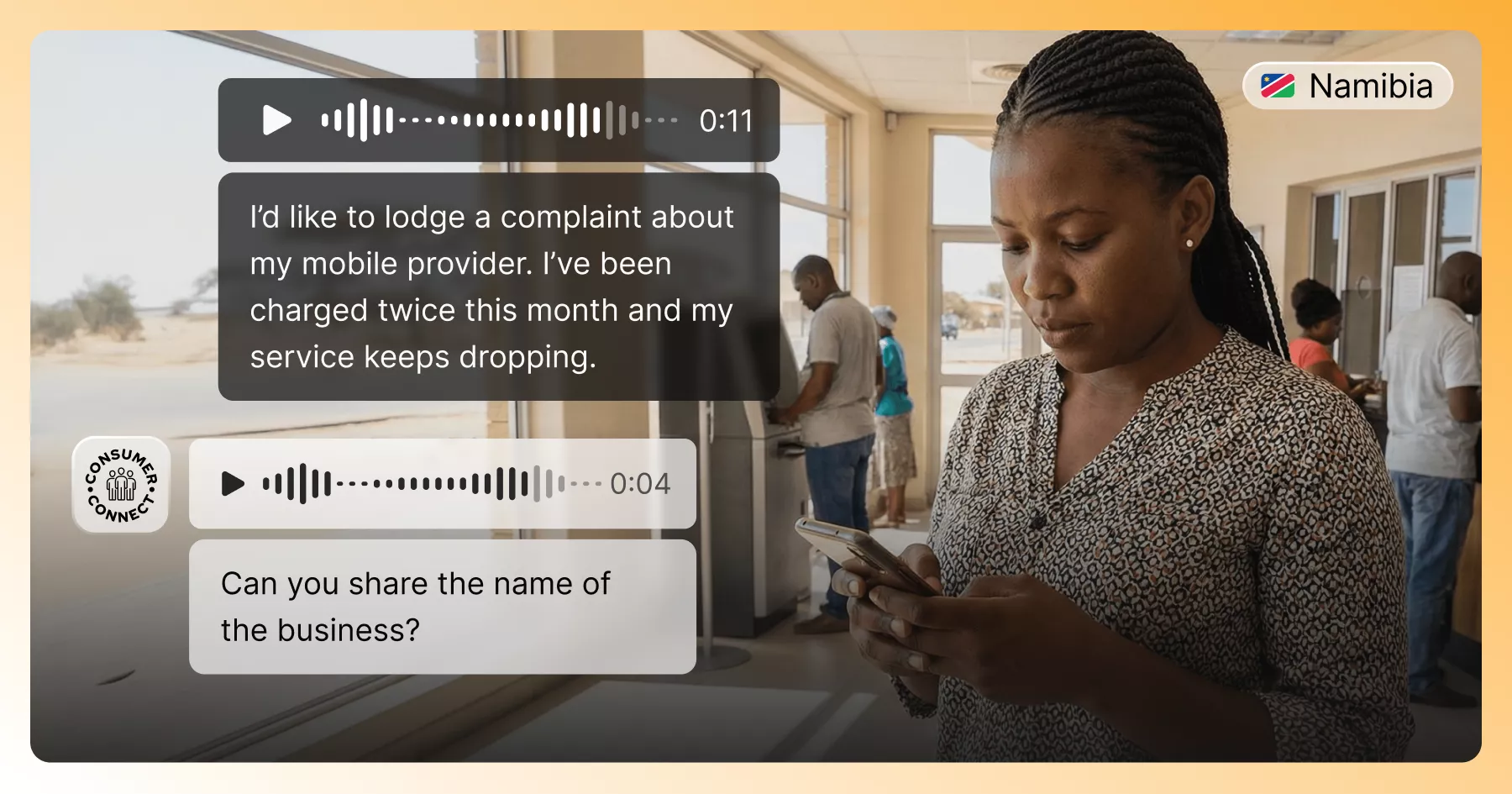
Likewise, in Namibia, voice AI is a critical element in the integrated Proto deployment for the ConsumerConnect system, which is hosted by the country's central bank, communications regulator, and financial supervisory authority. According to a 2024 TransUnion survey, 63% of Namibians report they had been targeted by email, online, phone call, or text messaging fraud within the preceding three months – and of that group, 11% confirmed they had become victims.
Gates Foundation Senior Program Officer Jeremiah Grossman said: "The Foundation is investing in consumer protection AI tools with the goal of building consumer trust in digital services for the lowest-income communities. Through these projects, the Foundation hopes to demonstrate the value of an automated grievance redress system for citizens, regulators and governments, and catalyse broader adoption across emerging markets.
With the complementary support from Canada's ScaleAI program, Proto continues to bridge the digital language divide in Africa and Asia. This outputs from this project promise to transform service delivery with accessible voice engagement for millions of people in their native languages.
About ScaleAI
ScaleAI is a Canadian innovation cluster dedicated to accelerating the adoption of artificial intelligence across various industries. As an independent, not-for-profit organisation, ScaleAI unites private enterprises, research institutions, and startups to build intelligent supply chains and enhance industry performance through AI-powered solutions. The organisation has facilitated the support of over 120 AI projects, amounting to investments of approximately $600 million, focusing on sectors such as healthcare, manufacturing, transportation, and information technology.