


Most digital complaints systems do one thing well: they help a consumer get their grievance to the right place. You submits a case, an AI classifies it, and it gets routed to the right bank, merchant, or regulator.
But then the hard part starts: redress.
The real work – reading the case, understanding what went wrong, looking at similar past cases, and deciding what a fair outcome should be – still falls entirely on a person. That is slow. And it means similar cases can end up with very different outcomes depending on who happens to be handling them.
This is the gap Proto is now focused on closing, especially as redress becomes a core component of digital public infrastructure like instant payments.
Two very different workloads in the same queue
In almost every market we work, two patterns play out side by side. A small share of cases are urgent, high-harm scams that do target vulnerable citizens – social protection beneficiaries, the elderly, the newly banked. These need a coordinated anti-scam response with authority to trace and freeze funds inside the 24-hour window in which recovery is realistically possible. A much larger share are everyday commercial disputes – failed transfers, refund refusals, poor customer service. Not life-altering, but at volume they are what shapes daily trust in the financial system.
Today both end up in the same overstretched queue, and the second category crowds out the first.
Dispute resolution as a service
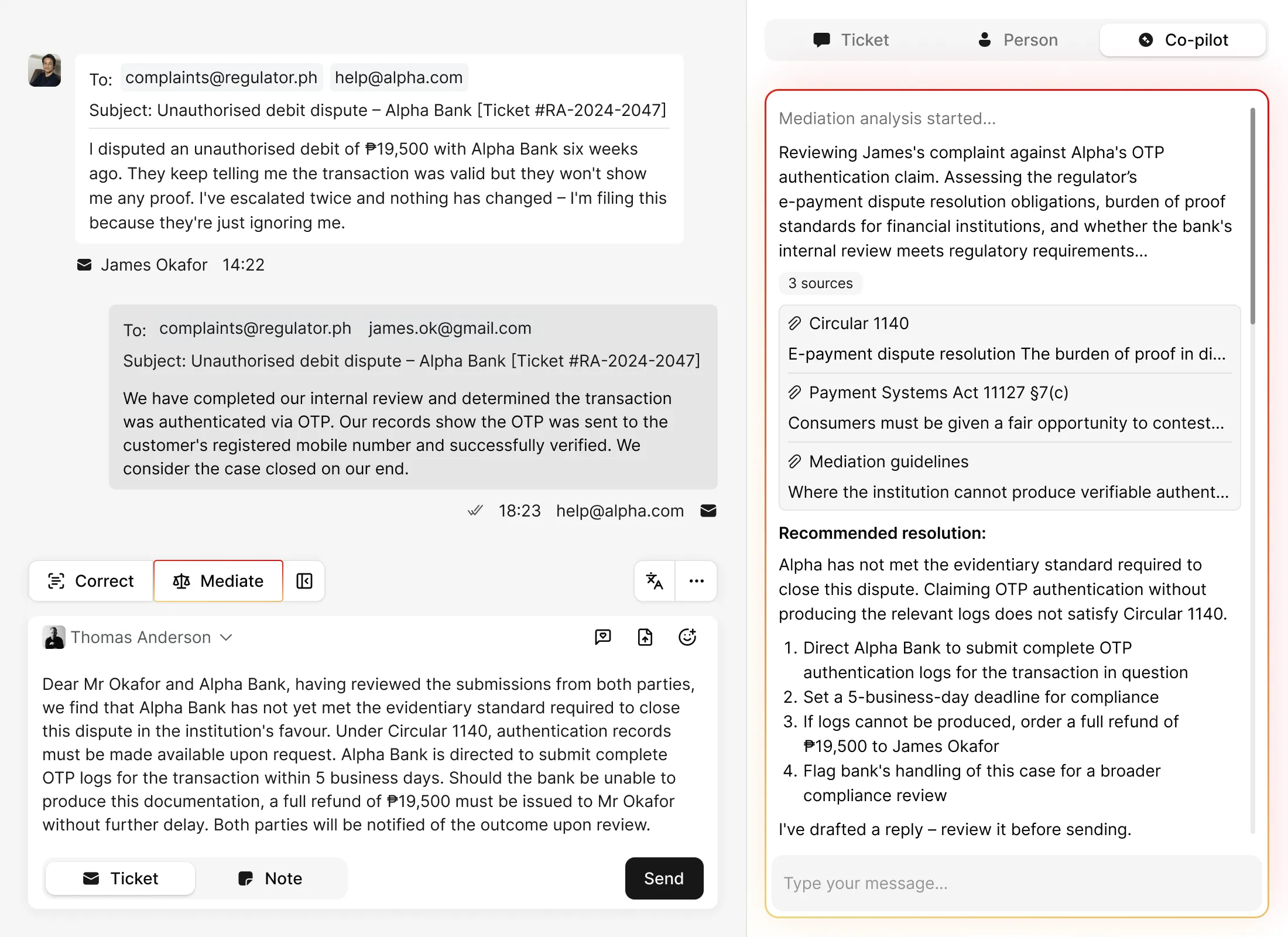
The next phase of our public sector roadmap is about AI-assisted mediation – which, in some cases, can be offered by regulators and instant payment operators as a service to financial institutions and their non-vulnerable consumers.
Over time, market supervisors build up thousands of closed cases. Those cases contain a lot of practical knowledge about what usually works, what doesn't, and what outcomes tend to be accepted by both sides. Today, that knowledge mostly sits in archives and spreadsheets.
We are turning that into a simple redress engine, trained on each country's regulatory policies, national laws, and case resolution history. When a complaint escalates to a dispute, the Proto platform can look at similar past cases and suggest a way forward that fits the local rules and the way that supervisors normally facilitate resolution or make a final decision.
This is not about replacing judgment. It is about giving the officer a strong starting point, instead of a blank screen. They can send a resolution as-is, edit it, or ignore it entirely. The final message still comes from the officer.
We are building this directly into the main inbox, not as a separate tool.
One layer in a wider trust architecture
AI-assisted mediation does not sit on its own. It is the dispute resolution component of a broader agentic trust layer that Proto and its partners are building for instant payment systems – alongside real-time fund tracing, account freezing, and victim fund return for scam cases.
By absorbing the high-volume commercial dispute load consistently and fairly, the mediation engine frees up supervisory resources to focus on what only humans can do, such as investigating organised fraud networks. Most central banks and supervisors we work with spend the bulk of their consumer protection capacity on case-by-case handling, with too little left for policy-making, supervision and market conduct review – the systemic work that actually moves the needle on trust. If AI-assisted mediation can absorb the routine load, that capacity goes back where it belongs.
Scalable redress as a launch condition, not an afterthought
A pattern is now visible across DPI rollouts worldwide. Countries invest heavily in the rails – digital identity, instant payments, data exchange – designed for scale, speed, and frictionless adoption. Then the harms start appearing: mistaken transfers, wrongful exclusions, contested transactions. Only after those harms accumulate do governments turn to redress, usually retrofitting fragmented complaint inboxes and call centres onto live infrastructure that was never designed to absorb them.
The question is no longer whether DPI systems will produce grievances; it is whether governments will build systems capable of resolving them.
Redress – powered by AI-assisted mediation – has to be a launch condition for the next generation of DPI, not a feature added once trust has already started to erode. By learning from past resolutions, institutions can become more consistent, faster and fairer from day one.