
Proto's Voice API – text-to-speech and speech recognition – is now available as its own product, managed independently of your existing Proto plan.
The capability itself isn't new. It's the same engine behind deployments like the National Bank of Rwanda's Intumwa AI agent and enterprise clients across the Philippines – including Bangko Sentral ng Pilipinas and PhilCare – supporting voice in Kinyarwanda, Tagalog, Cebuano and Ilocano across citizen engagement, consumer protection and anti-scam support. What's changing is how teams access and scale it.
The gap this closes
Mainstream text-to-speech and speech recognition engines remain inconsistent at handling low-resource languages – where voices sound like a converted English model rather than a native speaker, and recognition struggles with accents and mixed-language phrasing.
Until now, teams reaching these audiences through Proto had to fold Voice API usage into the same plan as their contact centre automation. That changes now. Voice API usage is purchased and managed independently of Proto's standard plans, as its own credit-based product – so teams can quickly scale voice access into underserved languages.
What's new
- Its own billing. Voice API requests are purchased as credits rather than counted against the interaction plan, available even on the free plan upward.
- Dedicated usage visibility. A usage dashboard breaks consumption down by language, teamspace and request type (TTS or ASR), so teams can see exactly where voice demand is coming from.
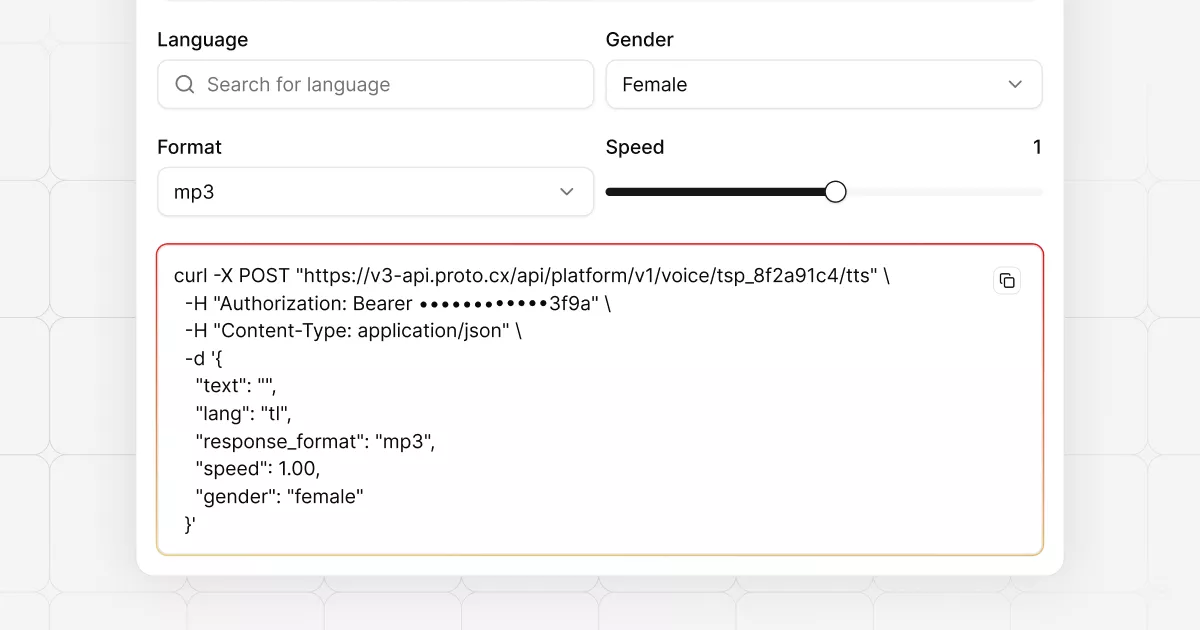
- Deployment tools, embedded. Voice API documentation and a request configurator now sit directly in the platform, next to the usage data, rather than in a separate portal.
- Low-credit alerts. Email and in-platform alerts flag when credits are running low, before they're gone.
Kinyarwanda and Tagalog are supported today, with more local languages being added. You can try text-to-speech and speech recognition directly at proto.cx/local-languages before signing up.
To get started, sign up on the platform, then go to Settings → Voice API.
Why it matters
Closing the voice gap has always been about more than accuracy – availability matters just as much. GiveDirectly's pilot in rural Rwanda is a clear example: recipients sent voice notes in Kinyarwanda over WhatsApp at all hours, well beyond typical service hours, because the language and channel were ones they already trusted. Proto's Voice API is built specifically for that: TTS trained on real local speech rather than a converted English voice, and ASR built to handle the accents and mixed-language phrasing people actually use.
Making Voice API its own product means teams can now scale it deliberately – purchasing exactly the voice reach they need, tracking it on its own terms, and growing it independently as new markets and languages come into scope.