
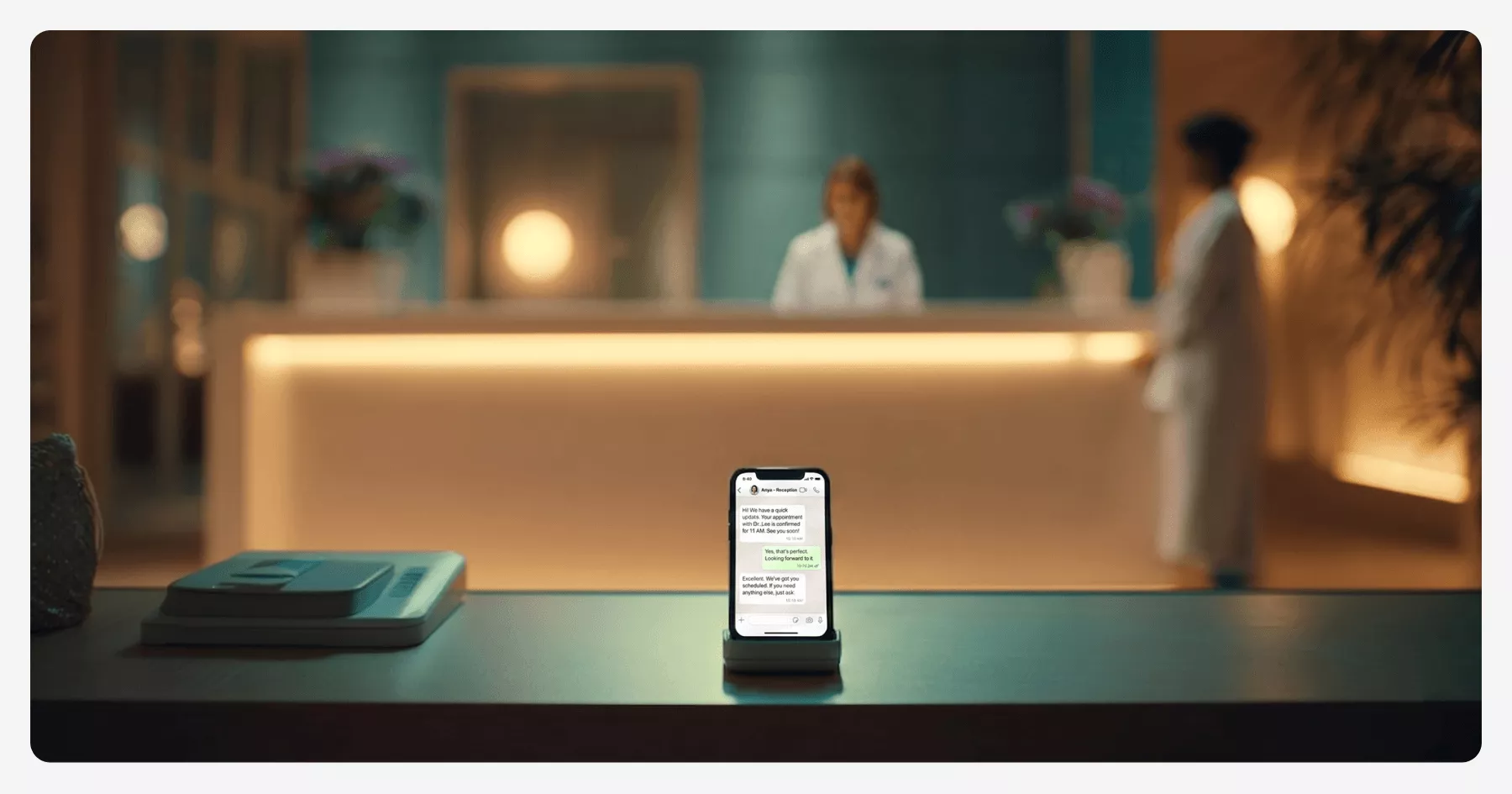
In private healthcare, patients choose their provider. In a concentrated market – where the same patient base selects from a small number of private hospitals – patient experience shapes that choice as much as clinical reputation. The hospitals that patients can still reach at 23:00, that deliver consistent post-operative guidance to every patient, that give instant access to a specialist directory without navigating switchboards or phone menus – those hospitals build a reputation that competitors without this infrastructure cannot match from a standing start.
The staff time reclaimed from repetitive, out-of-hours enquiries is measurable from the first months of operation. It does not require scale to materialise. Every hour freed from answering routine calls is an hour redirected to higher-value patient care – and every patient who gets an answer at the hour they need it is a patient whose experience of the hospital is shaped before a single clinical interaction takes place.
A 4.6/5 patient satisfaction score, achieved without a marketing campaign in the first month of a newly launched AI agent channel, is a leading indicator of the behaviour that drives private healthcare revenue: repeat visits, referrals, and the quiet preference that determines which hospital a patient contacts when they have a choice. In a concentrated market, that preference compounds. The alternatives are fewer. The patient base is smaller. Every experience that earns a recommendation is worth more.
Most hospitals know this. Fewer have acted on it in a way that changes what a patient actually experiences when they try to reach their provider outside of a consultation. Phone queues, business hours, manual paperwork, inconsistent post-operative follow-up – these are not edge cases. They are the default patient experience at the majority of private hospitals, and they are the gap that AI agents are now closing.
What the healthcare deployments show
Proto has been working with healthcare providers across Southeast Asia and Africa long enough to see what holds across different markets, systems, and patient populations. The pattern is consistent: when patients are given a digital channel that works – one that responds in their language, handles their query without delay, and is available at the hour they actually need it – they use it, they rate it positively, and the operational load on clinical and administrative staff drops.
At Healthway Medical Network in the Philippines – part of Ayala Corporation's AC Health, the country's largest healthcare network – Henry, the AI agent built on Proto's platform, now handles 93% of all patient interactions automatically, a rate that has grown 15% year on year. AI chat volume is 13 times higher than livechat volume. Within the first three months of deployment, Henry's handle rate doubled. These are not early-stage numbers; they reflect a deployment that has been live, iterated, and scaled across a large and linguistically diverse patient base – in Tagalog, Cebuano, and English, across webchat and Messenger.
The Medical City deployments across multiple facilities in the Philippines extend the scope further: medical procedure bookings integrated directly into clinical scheduling systems, multilingual voice messaging, and escalation pathways that preserve full conversation history when a case requires a human agent.
Across these deployments, Proto has developed and refined a broad set of patient-facing workflows:
- Appointment booking for doctor visits and medical procedures (CT scans, MRI, diagnostics)
- Symptom checking with appropriate escalation to clinical staff
- Lab test result delivery through AI chat
- Service and pricing enquiries
- Finding a clinic, hospital, or doctor – including directory lookup and in-facility wayfinding
- Letter of authorisation requests and HMO-related enquiries (procedure coverage, eligibility verification)
- Insurance claim submission
- Complaint capture and routing
- Pre- and post-operative proactive messaging
- Ambulance dispatch
Each of these workflows was built in response to real patient demand – not as a feature list, but as a set of problems that hospitals were already solving manually, and that AI agents could handle at scale.
The financial value of these systems is often misunderstood as labour reduction alone. In practice, the larger impact is usually on patient continuity, conversion, and retention.
In private healthcare, many patients disengage between stages of care:
- follow-up appointments are missed
- rehabilitation is never completed
- diagnostics are booked elsewhere
- or patients simply choose the provider that responds first
Every patient who drops out of the care journey represents both a continuity gap and lost downstream revenue.
This is where AI coordination layers really become commercially significant.
When patients can move directly from:
- consultation → specialist booking
- surgery → rehabilitation
- enquiry → imaging scheduling
- discharge → structured aftercare guidance
without friction or delay, completion rates improve and more care remains within the healthcare ecosystem.
Even small reductions in patient drop-off can materially impact revenue in concentrated private healthcare markets where hospitals compete for the same patient base.
What works in a smaller market
The same infrastructure that handles 93% automation across a large Philippine healthcare network applies in a compact private hospital group in Namibia – and even the first months of deployment demonstrated that the model holds at smaller scale too.
Two hospitals. Two AI agents. Five patient-facing workflows across WhatsApp and webchat in English, Afrikaans, and German. A support model that previously ran entirely on phone calls during business hours, replaced with 24/7 availability on the channels patients already use.
99.8% automation rate. 4.6 out of 5 patient satisfaction, built from real ratings with no marketing campaign active. 4-second AI first response time. An estimated 50 hours of reception and administrative staff time freed up in the first month alone – an early figure that will grow as patient awareness of the channel increases.
Specialist lookups – patients searching for a doctor or consultant by name or specialisation – accounted for nearly 1 in 10 of all conversations, fully automated. General information and billing queries accounted for another quarter.
The most unexpected finding: 42% of all conversations were about recruitment and job applications. A patient-experience deployment surfaced a high-volume HR use case that had previously been handled manually and inconsistently. Within a day of identifying the pattern, the agents were extended to surface open roles, confirm closed positions, and guide applicants through the submission process – without any manual HR involvement in first-contact enquiries.
What these deployments increasingly show is that AI patient engagement is no longer experimental infrastructure. It is already operating at scale – reducing operational load, improving continuity of care, and shaping patient preference in measurable ways.
In concentrated private healthcare markets especially, small improvements in responsiveness, continuity, and patient retention compound over time. The hospitals that adapt first are unlikely to win because of AI alone. They will win because patients increasingly remember how easy, responsive, and coordinated their healthcare experience felt – and choose accordingly.