
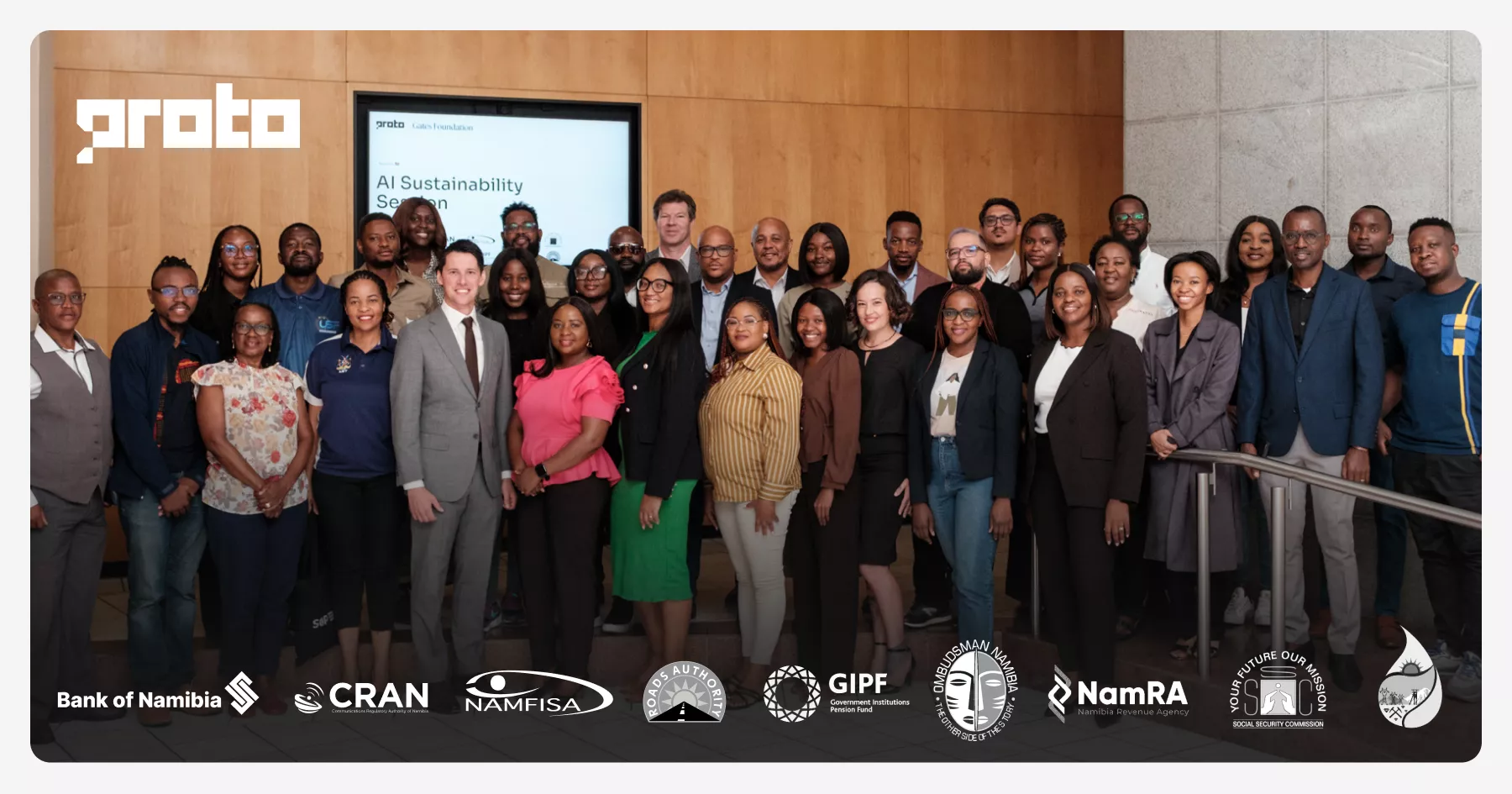
Regulators, public institutions, and technology partners gathered at the Bank of Namibia on Friday, 6 March to discuss the long-term sustainability of AI-powered citizen services in Namibia.
The session brought together representatives from the Bank of Namibia (BON), Communications Regulatory Authority of Namibia (CRAN), Namibia Financial Institutions Supervisory Authority (NAMFISA), Namibia Revenue Agency (NamRA), Government Institutions Pension Fund (GIPF), the Office of the Ombudsman, the Social Security Commission, the Roads Authority, and the Ministry of Mines and Energy, alongside technology partner Apex Business Solutions (ABS).
The discussion built upon the Gates Foundation–sponsored pilot ConsumerConnect – the AI-powered network of citizen support agents launched by BON and CRAN to simplify how citizens report scams, submit complaints, and access redress to protect consumer trust. The Proto platform enables complaints to be submitted through WhatsApp, web chat, and voice, automatically routing issues to the appropriate regulator or financial institution.
From pilot to government AI infrastructure
The AI sustainability session examined how the ConsumerConnect project could evolve from a donor-funded pilot into shared digital infrastructure across government.
The pilot was supported by the Gates Foundation's Inclusive Financial Systems programme, which provides catalytic funding to help governments deploy systems for payments and consumer protection. With the programme sunsetting in 2030, Proto and its public sector partners are focused on transitioning system ownership to national institutions.
Under the shared service model discussed during the session, multiple agencies would operate their own sovereign AI services while sharing core infrastructure such as software, data hosting, and AI models. This approach reduces the cost of each agency maintaining its own systems, while automating service workflows within their mandates.
Several participating institutions discussed potential use cases for AI citizen services – including:
- tax inquiries for NamRA,
- licensing services for CRAN,
- human rights complaints and referrals for the Ombudsman,
- appointment booking for the Roads Authority.
These use cases are designed with a hybrid data hosting architecture that keeps personally identifiable information on sovereign servers, while the country's data centres build out their GPU compute capacity.
The technology presented by Proto also emphasised inclusion and accessibility, supporting citizen engagement through familiar channels such as WhatsApp and voice calls, while incorporating AI capabilities for local languages such as Oshiwambo to reach citizens who may not typically interact with government systems in English. The Proto platform also analyses social media sentiment and generates leadership insights to help public authorities detect emerging risks and study policy effectiveness.
To deliver upon the shared service at scale, Proto introduced its local partner Apex Business Solutions (ABS) to provide implementation and support capacity in Windhoek. This partnership follows Proto's model of developing AI solutions for low-resourced languages and institutional workflows, while supporting job growth with local SME partnerships.
Proto’s CEO Curtis Matlock and Country Manager Christine Vrey attended the AI sustainability session, with facilitation by Bank of Namibia’s Senior Analyst for Policy & Regulation Roline Tjipueja (1) and opening remarks from CRAN’s Executive for Cybersecurity & ICT Elton Witbooi (2). ABS Managing Partner Hafa Nghipumbwa (3) provided the local SME perspective on operationalising the shared service model.
Achieving Namibia's NDP6 objectives
Participants also linked the initiative to the Sixth National Development Plan (NDP6), which identifies coordinated digital infrastructure and improved public service delivery as key priorities. Relevant objectives include:
- DO0408: Increasing citizen satisfaction with public service delivery from 54% to 70% by 2030
- DO0132: Investing in digital infrastructure to position Namibia as a stronger participant in the global digital economy
- DO0122: Strengthening institutional mechanisms to reduce illicit financial flows with anti-scam capabilities
These priorities highlight the importance of integrated digital systems across government, rather than siloed and costly technology deployments. The session emphasised the opportunity to expand upon the ConsumerConnect project to achieve these national goals.
Proto CEO Curtis Matlock said: "Namibia has the opportunity to build sovereign AI infrastructure that serves citizens across multiple agencies. By collaborating on shared systems rather than procuring them individually, institutions can reduce costs and accelerate innovation while delivering better services."
The AI shared service model is ready to deploy in the new fiscal year, with government agency onboarding to be completed this month.
.webp)
.webp)
.webp)
.webp)